Friday, March 15, 2019

Biographical Poetry


Biographical Poetry

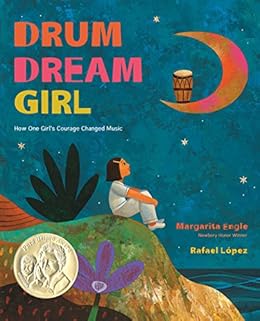
Image result for drum dream girl

Bibliography
Engle, Margarita. 2015. Drum dream girl: how one girl’s courage changed music. New York, NY: Houghton Mifflin Harcourt Publishing. ISBN: 9780-544-10229-3

Summary/Analysis
This poetry picture book by Margarita Engle tells the story of Millo Castro Zaldarriaga in Cuba during the early 20th century.  Millo broke the taboo that only boys should be allowed to play drums and later became a world famous musician.  The entire book is one narrative free verse poem that begins with her dream of becoming a drummer and ends with her achieving that dream.  Engle uses descriptive adjectives to help bring the sounds to life, alliteration, and onomatopoeias like “boom boom booming” to really listen and hear the sounds.  The illustrations by Rafael Lopez help capture the emotions of the story and the colorfulness of the island’s culture. There is not a table of contents but there is a historical note that is included at the end of the book that helps provide some more details on Millo’s life and historical importance.  

Use
(excerpt from last page)

where everyone who heard
her dream-bright music
sang
and danced
and decided
that girls should always be allowed to play
drums

and both girls and boys
should feel free to dream.

After reading this poem I would ask students to imagine that all of a sudden they were not allowed to go to recess because they were a boy or a girl.  Let them discuss how that would make them feel and then see if students can think of any examples of things in our world that girls or boys are not allowed to do because of their gender.  I would then read this poem aloud again and talk about dreams they have like Millo.  Other activities could include having a student or the class tap their desks/drums to a beat while we all read the poem together.  After reading the poem I would also show students photos of Millo and let them listen to music made by her and her sister’s band.


Social Studies Poetry


Social Studies Poetry

Image result for voice of freedom fannie


Bibliography
Weatherford, Carole Boston. 2015. Voice of freedom: Fannie Lou Hamer, spirit of the civil rights movement. ISBN: 978-0763665319

Summary/Analysis:
Voice of Freedom is a collection of 22 poems that tell the story of Fannie Lou Hamer.  Written in conversational free-verse the text by Weatherford incorporates direct quotes from Hamer that flow together throughout the book.  The poems describe life under Jim Crow all the way to her becoming a national hero and civil rights activist.  Some poems cover difficult but necessary subjects like her life under Jim Crow and forced sterilization because of a Mississippi law and brutal beatings at the hands of police officers.  The book follows her life and provides insight into high and low points of her life while providing a brutal and honest picture of what took place in history.  The book is all free-verse and line breaks assist with creating a spoken rhythm pattern in most of the poems.  Direct quotes from Hamer are included in the lines and there is an added source note in the back with information on the direct quotation used.  Colored collage illustrations by Ekua Holmes use scraps of historical photos, newsprint, maps, and other media add to the poems and experiences. There is no table of contents present, but there is a detailed timeline, an author’s note, source notes, and a bibliography. 

Use:

The Price of Freedom

Before I could cast a single vote,
I had to pay a poll tax I couldn’t afford--
and dodge the night riders
who cruised slow as molasses
past my house with guns
after my name was printed in the paper.
Too bad a voter registration card
couldn’t pay the rent.
When Pap lost his job, we got by
on ten dollars a week raised
by those young voting-rights workers
who opened my eyes
to the change a-coming.
I hopped aboard that train.

The poems in this biography all flow together, but many of them are able to stand alone.  While this poem does not contain any direct quotes by Hamer it offers a glimpse into something that she had to endure and overcome.  Before reading the poem be sure to have students research and understand the history of what was happening and what the purpose of a “nightrider” was.  After reading the poem discuss what was happening and why the voting-rights workers helped her family out.  Discuss why people did not want her or other African Americans voting.  Focus on the last line of the poem “I hopped aboard that train.”  Have students discuss if it was a real train and why Weatherford chose to use that imagery.


Science Poetry

Science Poetry

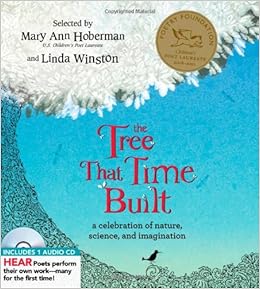
Image result for tree that time built


Bibliography:
Hoberman, Mary & Winston, Linda. 2009. The tree that time built: a celebration of nature, science, and imagination. Napperville, IL: Sourcebooks, Inc. ISBN: 9781402225178.

Summary/Analysis:
This anthology of poems focuses on the mysteries and facts found in the natural world.  The poems were selected by Linda Winston, a teacher and anthropologist, and Mary Ann Hoberman, a former U.S. Children’s Poet Laureate.  The anthology has over 100 poems from well known poets (including Hoberman) that are divided into nine different sections that help organize the poems.  Each section begins with a short introduction explaining the theme, connecting it back to Darwin, providing important vocabulary, and giving readers a framework for the poems that are in that particular section.  A variety of poetic forms are used including free verse, rhyming, concrete, haiku, and many others.  There is an accompanying CD included that has many poems read by the actual poet.  This is a great way for readers to hear the intended rhythm and hear famous poets read their own works.  Even with the large amount of poems, the sections  help keep the poems organized and they all flow well together.  Poems range from being serious with poems focused on not harming living things to fun and light hearted poems about flying like a bird.  The poems and vocabulary used are best suited for students in upper elementary and middle school, but even younger readers will appreciate many of the simple poems.  The anthology contains an introduction about Charles Darwin and how the book was created.  There is a table of contents, index, and a glossary.  Also found is a section “About the Poets” that has basic biographical information on each poet and information on each of the compilers.  Students who enjoyed the topic and poems will also find the “Suggestions for Further Reading and Research” to be of interest when finding more resources related to the topics found in the book.

Use:

Think Like a Tree by Karen I. Shragg

Soak up the sun
Affirm life’s magic
Be graceful in the wind
Stand tall after a storm
Feel refreshed after it rains
Grow strong without notice
Be prepared for each season
Provide shelter to strangers
Hang tough through a cold spell
Emerge renewed at the first signs of spring
Stay deeply rooted while reaching for the sky
Be still long enough to
Hear your own leaves rustling.

This poem by Karen Shragg is an example of the many types of poetic forms found in this anthology.  In the book this is a concrete poem and appears as an evergreen tree.  This poem is also read aloud by the poet in provided CD.  The section that this poem is found in features other poems about trees and their importance in our world.  After reading the poem out load as a class you could play the audio recording of the poet.  Sharing this poem could be an easy way to reintroduce concrete poems to the class.  This could be done along with a science unit focusing on forests or trees.  Each group could be assigned a different type of tree and they would have to write a factual poem that they turn into a concrete poem to represent the shape of the tree.