Free Choice
Bibliography
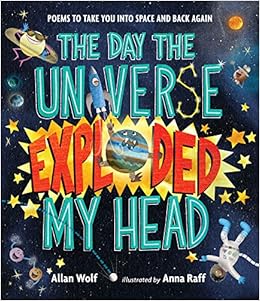
Wolf, Allan and Raff,
Anna. 2019. The Day the Universe Exploded My Head: Poems to Take You
into Space and Back Again. Somerville, Massachusetts: Candlewick
Press. ISBN 978-0763680251.
Summary/Analysis
This poetry collection
by Allan Wolf focuses on stars, planets, moons, and other things found in outer
space. The 28 poems contain facts about different topics (Mercury is
first planet, no atmosphere, etc.) and they are presented in a light and funny
way. The accompanying illustrations reinforce the topic and add a playful
and silly feel to each poem. Most poems
have some sort of rhyme and there are several poems meant to be performed by
multiple people (Shooting Stars has three roles). The collection
includes notes about each poem with some notes as brief as one sentence and
others as long as a paragraph. There is also a glossary of space terms, a
list of resources, and information on each space topic found in the back of the
book.
Use
The Sun Did Not Go Down
Today
No matter what the poets
say,
the sun did not go down
today!
The sun did not go down
today!
It only just appeared
that way.
I’ll tell you what real
facts is:
the Earth is turning on
an axis!
The Earth turns on its
axis
like a dizzy, spinning,
tilted top.
Each year, three hundred
sixty five
complete rotations
without stop.
And as it spins, we all
stand firm
and ride it round with
every turn.
The sun remains there in
the sky
and waves at use as we
go by
on our spherical,
miracle merry-go-round.
So next time you notice
the sun “going down,”
watch in awe, but don’t
forget:
The sun stays put, it’s
you who’s set.
This poem is a good
example of the simple rhyming poems found in the book. It provides
factual information on the sun and gives students good vocabulary like “axis”
and compares it to a top. The illustrations by Bryan even show the Earth
spinning like a top. This poem would be
best introduced during a science unit discussing season, how the Earth rotates,
and/or the sun. After reading this poem out loud students could take
turns coming up and creating different motions for each line of information or
for specific parts (“all stand firm”, “dizzy spinning top”). Students
could take turns acting it out with one student pretending to be the sun and
the other pretending to be the Earth.