Wednesday, February 27, 2019

New Poetry Book


New Poetry Book


Image result for can i touch your hair

Bibliography

Latham, Irene and Waters, Charles. Can I Touch Your Hair? Poems of Race, Mistakes, and Friendship. Minneapolis, MN: Caralrhoda Books. ISBN: 978-1-5124-0442-5


Summary/Analysis

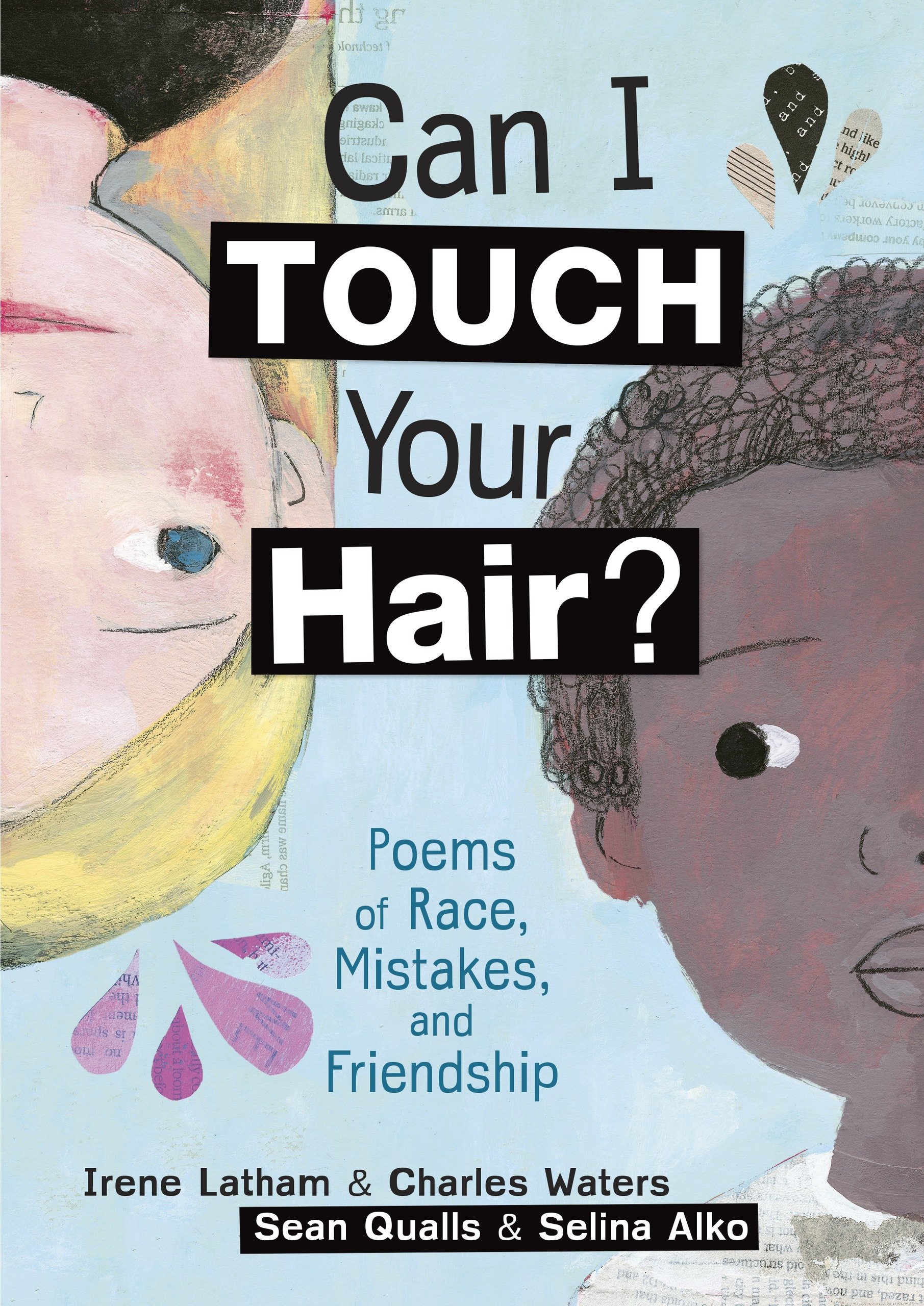
Can I touch Your Hair? is a wonderful poetry book that tells the story of two students who get stuck working together on a poetry project. Irene is white and Charles is black. The topics of the poems cover racial differences in the context of the friendship of the two students. Later on in the book the poems cover deeper topics like police violence against African Americans. The poems serve as a way for the kids to share their experiences and how they are both different and similar. The color of the font for each poem is used to depict who the poem is written by. If it is Irene the title is in white font over black and Charles it is a bold, black font. The poems use their natural language and do not follow a particular rhyme scheme, but they are full of wonderful imagery and metaphors like “sugar-sand white” and “pale as a cloud.” This makes the poems easy to follow and understand. All 33 poems do a good job flowing together and the reader feels like they are listening in on two friends having a conversation. The illustrations by husband and wife Sean Qualls and Selina Alko do a wonderful job adding to each poem and illuminating the similarities and differences of the writers. For the Poems “Officer Brassard” and “News” the illustrations show Charles watching a TV screen depicting the “pale as a cloud” police officers getting a not guilty verdict while Irene’s illustration shows her dad avoiding the bad news and them sitting at a park (where they talk about the difficult issues). The poetry book does contain a table of contents and lists the titles of each poem. The end contains both an author’s note and illustrators’ note discussing the process of writing the poems while at a distance and how the teacher in the book was based on one of Charles’ actual teachers who inspired him and served as a “beacon of light.”


Use


Beach Day


There’s a pack of guys and girls, whose pearly skins

have been baked into a bronzed hue, strolling past me.

Each of them has hair woven into cornrows

or twisted into dreadlocks.

Some of their lips jut out like puffer fish.

When I wave, they look at each other, begin snorting,

laughing at my good manners.

I feel a fury rising inside me, as if I’m a

tidal wave about to crash on land.

I’m confused: why do people who

want to look like me hate me so much?


This poem is a great example of taking something simple, like a day on the beach, and using it to show the different experiences by the two young poets. Read the poem to the class and ask if anyone can help explain what Charles was feeling while at the beach. Have them compare to Irene’s poem. The class could also create a list of things that make them “feel a fury rising” inside of them. They could create one large wave out of paper and display all of the things that make them feel the same way as Charles.

Verse Novel


Verse Novel


Bibliography

Holt, K. A. 2014. Rhyme Schemer. San Francisco, CA: Chronicle Books. ISBN: 9781452127002


Summary/Analysis
Rhyme Schemer is a free verse novel told from the perspective of a bully. The first poem of Day 1 describes Kevin’s intentions of bullying early on with the end reading “So many / weenies. / So little / time.” Kevin’s victims are the a student in his class named Robin and at some points the mole on his new teacher’s face. Later on Robin obtains the notebook of Kevin’s poetry and ends up blackmailing him. Kevin ends up having to help in the library and finds a librarian who is looking to help him from getting expelled and gets him to a poetry reading. Kevin eventually begins to have compassion for his fellow classmates and sees himself as a poet. There is not a consistent rhyme pattern throughout the book (very sparse) but the poems are full of figurative language and repetition (“Poetry Boy” p.60). Added drawings/doodles on the pages add to the story and poems as well as the “found poetry” that is used by torn pages from class novels to create newer verses. The verse novel is sure to be easily enjoyed by 5th-8th grade boys, but elements of bullying and transformation are easily enjoyed by most students. The poems are easily understandable and all flow well to tell the story. There is no table of contents, but at the end of the book there is a page of acknowledgements, discussion questions, and some writing and speaking connections.


Use
"Day 25"

Poetry boy.

You’d think they could come up with something
better.

Poetry boy! Poetry boy!
Who’s so tough now?

Poetry boy? Poetry boy!
Where’s your dress?

Poetry boy! Poetry boy!
Harry’s out to get you now.

Why is poetry boy a bad thing
when everyone loves the pages i put on the
walls?

Isn’t that like poetry, too?
Messing with sentences to make new ones?

I’m no boy, I’m an outlaw.
I’m a poetry bandit.

Maybe I should tell my secret.
Spill the beans.

Except what about zero tolerance?
What about MAJOR CONSEQUENCES, MISTER?

It’s all so dumb.
It doesn’t bother me.

Poetry boy! Poetry boy!
Whatever.

Robin is their leader,
By the way.

He thinks i’m easy prey
as he leads the chants
with his juicy dog-bone face.

That I can’t hit.
Anymore.

This poem captures a turning point for the poet going from bully to victim. It also highlights Holt’s use of repetition and figurative language. Before reading the poem make sure that students have an understanding of the story up to this point. After reading the poem out loud discuss how different he is feeling now compared to the first poem of the book. Then use Holt’s “Connecting with Social Issues” at the back of the book. Have students discuss how they can create a classroom environment that shows mutual respect and care for one another.

Poetic Form

Poetic Form

Image result for echo echo reverso poems


Bibliography:
Singer, Marilyn.  Echo Echo: Reverso Poems About Greek Myths. New York, NY: Dial Books for Young Readers. ISBN: 978-0-8037-3992-5

Summary/Analysis:
Echo Echo is a collection of 14 poems that focus on classic Greek myths.  Each poem composed by Marilyn Singer is a reverso poem, meaning that the poem can be read both forwards and backwards.  Each set of poems, both regular and reverso, is accompanied by a full page illustration by Josee Masse.  The illustrations do a wonderful job mirroring the poems with one half going with first poem and the other half going with the reverso.  In the poem “Pandora and the Box” the first illustration goes along with the poem and represents  Pandora and her not opening the box.  The picture is colorful and the box is black.  The reverso poem and illustration show the chaos after she opened the box.   Each poem and reverso do a wonderful job presenting two sides of each Greek myth.  The poems do no follow a specific rhyme scheme, but there is rhyming present in each poem. These poems and illustrations are quite enjoyable, but the reverso style can make it difficult to read and most likely not interest younger readers.  Each poem has details about the myths presented and provide readers with just enough information to understand the content of the poems if they needed a refresher.  There is no table of contents in the book, but there is an “About This Book” section at the end.  The page provides information on Greek mythology, reverso poems, and offers suggestions on where to read the myths in full length.  

Use:

Perseus and Medusa

There is no man who wouldn’t be                             
scared stiff.
Petrified indeed,
I must have your head,
 stone-hearted monster!
I am the chosen
one to rid the world of you nasty creatures.
It is my curse to be the
hero.
Look away.
You cannot
shield yourself from me.

Shield yourself from me?
You cannot
look away,
hero.
It is my curse to be the
one to rid the world of you nasty creatures.
I am the chosen
stone-hearted monster.
I must have your head,
petrified indeed--
scared stiff.
There is no man who wouldn’t be.

These poems are a perfect example of the reverso style and showing the different perspectives of the Greek myth.  The illustrations also easily show the point of view from each person in the poem.  One activity to teach perspective would begin with students reading each poem aloud.  There could be a brief discussion of the myth and the differences in perspective from each character in each poem. The teacher could break up the class into two groups with one being Perseus and the other Medusa. Using the same Greek myth students could use the information provided to create short stories that are told from that character’s perspective.  The class could then take turns reading the short stories going back and forth from characters. 

Thursday, February 14, 2019

Florian Poetry

Florian Poetry

Image result for comets stars moon mars


Florian Poetry

Florian, Douglas. 2007. Comets, Stars, the Moon, and Mars. New York: Harcourt.. ISBN 978-0-15-205372-7

Summary/Analysis
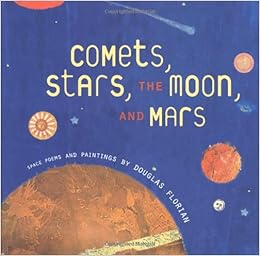
This collection of 20 poems by Douglas Florian all focus on outer space.  The book uses circle cut outs that transfer to the next page’s illustration.  This is even found as early as the title page and the table of contents (very helpful when using this collection for potential science/space projects).  The back contains a “Galactic Glossary” and provides more information about each poem’s focus.  Also provided is a selected bibliography and suggestions for further reading about space.   Each poem features a double-page illustration featuring collage elements and thematic circle cutouts that all reinforce each poem’s feel.  The verse throughout the collection is characteristically playful and what readers have come to expect from Florian.  In one poem called “a galaxy,” Florian spirals the words in the poem and the illustrations feature a different type of galaxy shape with the name stamped.  Each poem in this collection has a fun and almost bouncing rhythm that lends each one to a fun read aloud as a class or individually.  Rhyming is present throughout the collection, but does not follow a specific pattern.  The poems are all quite short, but readers will definitely want to read each one more than once and examine the illustrations to learn more about the topic.  The poems will definitely appeal to a younger audience, but older students could still enjoy the fact-filled poems in conjunction with a science unit.  The poems in this collection all flow well together and each poem gives the topic/place it’s own voice.  The illustrations truly tie everything together and act as an extension of each poem while also fitting in well together. 

Use

the constellations
Leo is a lion.
Lepus is a hare.
Cancer is a crab.
Ursa Major is a bear.
                        Lupus is a wolf.
                        Cetus is a whale.
                        Taurus is a bull,
                        From his horns down to his tail.
                                    Pisces is two fish.
                                    Musca is a fly.
                                    And Cygnus is a swan
                                    In this zoo up in the sky.
This poem does  great job capturing the bouncy, rhythmic style of the poems found in the collection.  After reading this poem it would be a great opportunity to study other famous constellations and the stories behind them.  Students could research famous constellations and come up with their own poem about the constellation focusing on the myth and story.  Students could also create illustrations to go along with their poems.  The class could have a night time event (or just turn out the lights) and pretend to be “gazing” at the stars while classmates read their poems.    


Multicultural Poetry

Multicultural Poetry

Image result for yum mmmm que rico


Bibliography
Mora, Pat, and Rafael López. 2007. Yum! mmmm! qué rico!: Americas’ sproutings. New York: Lee & Low Books Inc. ISBN 978-1584302711.
Summary/Analysis
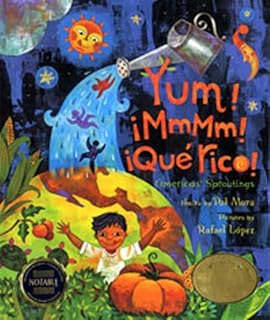
This collection of 14 poems by Pat Mora focus on foods that are native to the Americas.  There is no index or table of contents found in the book.  The collection of poems are all Haikus (her first haiku book) and are consistent in both theme and quality.  Each poem features a double page spread illustration by Rafael Lopez that adds depth to the poem.  For the poem “Chocolate” the illustrations feature a chocolate castle, cake, and a girl eating a chocolate chip cookie.  Each haiku  poem focuses on a different food and is accompanied by a paragraph of expository text detailing the facts of that food.  Most information about the foods feature the Spanish words giving the reader a deeper understanding of the food and exposure to a new language.  The poems are simple and easy for younger students to understand and the topic of food is sure to engage and speak to readers of all ages.  The mood of the poems is happy and each illustration is helpful in reinforcing that feeling.  The end of the book has a page with a “Dear Reader” section.  Mora incorporates all of the foods in the poems into a “fast-clapping” rhyme.  She then discusses why she chose to write a haiku book and why she focused on food. 

Use

Vanilla

Quick! Lick white river
running down the cone cooling
your warm summer laugh.

Before introducing the poem I would focus on vanilla and read the fact box on the side of the poem with information about vanilla.  If possible I would bring a vanilla pod and have students smell and come up with as many words to describe the smell/sensation.  After reading the poem as a class I would break up students into groups and assign them different ice cream flavors (the poem “Vanilla” is about vanilla ice cream).  Each group would have to write their own haiku about their specific ice cream flavor.  A possible extension lesson for social studies could focus on the Totonac Indians of Mexico and their way of life. 


NCTE Award Poetry

NCTE Award Poetry

Image result for poems in the attic


Bibliography
Grimes, Nikki. Poems in the Attic. 2015. New York: Lee & Low Books Inc. ISBN 978-1518108631.

Summary/Analysis
Poems in the Attic is a collection of 35 poems by NCTE Award winning poet Nikki Grimes.  The poems come together to tell a story about a little girl who finds a box of her mother’s poems about her travels as an Air Force kid.  Poems in free verse (typically first on the page) are by the little girl and poems written by the mother are written in Tanka (Grimes mentions that she uses the specific pattern: 5,7,5,7,7).  The illustrations by Elizabeth Zunon offer a deeper insight to the poems location like in the poem Aurora Borealis Zunon beautifully depicts the “dancing rainbow” that is mentioned in the poem.  The illustrations also offer a helpful guide in the story.  The girl’s poems are above an illustration bordered in an oval while the mother’s poems are a full page spread.  Towards the end of the book the poems come together as the girl sees her mother again and gifts her poems of her own.  The poems all flow together with ease and the imagery used in the poems are brought to life with the illustrations. There is no table of contents or index present, but there is an Author’s Note and a list of the United States Air Force Bases that were used in the book (each base has the name of the poem listed).  The very last pages Grimes informs readers on the poetic forms that she used and invites the reader to create their own.

Use

Aurora Borealis

My brother and me
held hands, breathless, as we watched
this dancing rainbow
shimmy ‘cross Alaska’s sky
in a skirt of night and light.

This poem in tanka form really captures Grimes’ use of imagery with “dancing rainbow” and “skirt of night and light.”  The illustrations also help complete the full image for the reader.  I would read the poem several times and then ready Grimes’ information on Tanka poems.  After reading about tanka poems and talking about how they focus on mood and are “about love, the four seasons, the shortness of life, or nature” I would have students pick a theme and write their own tanka poem using the same 5,7,5,7,7 syllable format that Grimes used in her book.  Possible extension could be tied to social studies lesson and focus on Japan and Tanka poetry or on the different places that the mother visited in the book.