Bibliography:
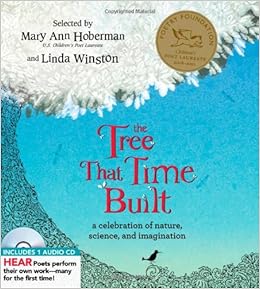
Hoberman, Mary & Winston, Linda. 2009. The
tree that time built: a celebration of nature, science, and imagination.
Napperville, IL: Sourcebooks, Inc. ISBN: 9781402225178.
Summary/Analysis:
This anthology of poems focuses on the mysteries
and facts found in the natural world. The poems were selected by Linda
Winston, a teacher and anthropologist, and Mary Ann Hoberman, a former U.S.
Children’s Poet Laureate. The anthology has over 100 poems from well
known poets (including Hoberman) that are divided into nine different sections
that help organize the poems. Each section begins with a short
introduction explaining the theme, connecting it back to Darwin, providing
important vocabulary, and giving readers a framework for the poems that are in
that particular section. A variety of poetic forms are used including
free verse, rhyming, concrete, haiku, and many others. There is an accompanying CD included that has
many poems read by the actual poet. This
is a great way for readers to hear the intended rhythm and hear famous poets
read their own works. Even with the large amount of poems, the
sections help keep the poems organized
and they all flow well together. Poems
range from being serious with poems focused on not harming living things to fun
and light hearted poems about flying like a bird. The poems and vocabulary used are best suited
for students in upper elementary and middle school, but even younger readers
will appreciate many of the simple poems. The anthology contains an
introduction about Charles Darwin and how the book was created. There is a table of contents, index, and a
glossary. Also found is a section “About
the Poets” that has basic biographical information on each poet and information
on each of the compilers. Students who
enjoyed the topic and poems will also find the “Suggestions for Further Reading
and Research” to be of interest when finding more resources related to the
topics found in the book.
Use:
Think Like a Tree by Karen I. Shragg
Soak up the sun
Affirm life’s magic
Be graceful in the wind
Stand tall after a storm
Feel refreshed after it rains
Grow strong without notice
Be prepared for each season
Provide shelter to strangers
Hang tough through a cold spell
Emerge renewed at the first signs of spring
Stay deeply rooted while reaching for the sky
Be still long enough to
Hear your own leaves rustling.
This poem by Karen Shragg is an example of the
many types of poetic forms found in this anthology. In the book this is a
concrete poem and appears as an evergreen tree.
This poem is also read aloud by the poet in provided CD. The
section that this poem is found in features other poems about trees and their
importance in our world. After reading
the poem out load as a class you could play the audio recording of the poet.
Sharing this poem could be an easy way to reintroduce concrete poems to
the class. This could be done along with
a science unit focusing on forests or trees.
Each group could be assigned a different type of tree and they would
have to write a factual poem that they turn into a concrete poem to represent
the shape of the tree.

No comments:
Post a Comment