Sidman Poetry
Bibliography
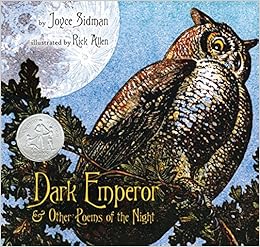
Sidman, J. 2010. Dark emperor and other poems of
the night. Boston, MA: Houghton Mifflin Harcourt. Illustrated by Rick Allen.
ISBN:9780547152288
Summary/Analysis
“Dark Emperor and Other Poems of the Night” is a
collection of 12 poems by Joyce Sidman. Sidman uses lyrical, rhyming
(variety of schemes), concrete, and verse forms to create poems about animals
and other things of the night. Each poem is easy to follow and Sidman
tailors the mood of the poem to the subject she is focusing on. Each poem and illustration takes up a double
page spread and is accompanied by a paragraph of factual information on the
subject. The illustrations by Rick Allen assist the poems and really help
the reader understand the mood and tone of each poem while also reinforcing the
facts found in the poems. The book
contain a table of contents and also a glossary featuring some of the
scientific terms found in the book.
Use
Welcome to the Night
To all of you who crawl and creep,
who buzz and chirp and hoot and peep,
who wake at dusk and throw off sleep:
Welcome to the night.
To you who make the forest sing,
who dip and dodge on silent wing,
who flutter, hover, clasp, and cling:
Welcome to the night!
Come feel the cool and shadowed breeze,
come smell your way among the trees,
come touch rough bark and leathered leaves:
Welcome to the night.
The night's a sea of dappled dark,
the night's a feast of sound and spark,
the night's a wild, enchanted park.
Welcome to the night!
This rhyming poem is the first poem that Sidman
uses to introduce the other poems and subject of this book. After reading
the poem out loud I would have students come up with examples of animals that
would go with specific lines of the poem. For the line “to you who make
the forest sing” I would have students think of examples of animals that “sing”
in the forest at night. I would do this
activity for each line (smells, touch, etc.) and have students share any other
ideas for future lines of the poem. This poem could also be read in the
dark with ambient forest sounds playing in the background. Do both and have students discuss the
different experiences and how they both changed the way they heard or
experienced the poems.

No comments:
Post a Comment