Florian Poetry
Florian Poetry
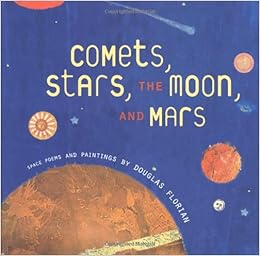
Florian, Douglas. 2007. Comets,
Stars, the Moon, and Mars. New York: Harcourt.. ISBN 978-0-15-205372-7
Summary/Analysis
This collection of 20
poems by Douglas Florian all focus on outer space. The book uses circle
cut outs that transfer to the next page’s illustration. This is even
found as early as the title page and the table of contents (very helpful when
using this collection for potential science/space projects). The back
contains a “Galactic Glossary” and provides more information about each poem’s
focus. Also provided is a selected
bibliography and suggestions for further reading about space. Each
poem features a double-page illustration featuring collage elements and
thematic circle cutouts that all reinforce each poem’s feel. The verse throughout the collection is
characteristically playful and what readers have come to expect from Florian.
In one poem called “a galaxy,” Florian spirals the words in the poem and
the illustrations feature a different type of galaxy shape with the name
stamped. Each poem in this collection
has a fun and almost bouncing rhythm that lends each one to a fun read aloud as
a class or individually. Rhyming is present throughout the collection,
but does not follow a specific pattern.
The poems are all quite short, but readers will definitely want to read
each one more than once and examine the illustrations to learn more about the
topic. The poems will definitely appeal
to a younger audience, but older students could still enjoy the fact-filled
poems in conjunction with a science unit. The poems in this collection
all flow well together and each poem gives the topic/place it’s own voice. The illustrations truly tie everything
together and act as an extension of each poem while also fitting in well
together.
Use
the constellations
Leo is a lion.
Lepus is a hare.
Cancer is a crab.
Ursa Major is a bear.
Lupus
is a wolf.
Cetus
is a whale.
Taurus
is a bull,
From
his horns down to his tail.
Pisces
is two fish.
Musca
is a fly.
And
Cygnus is a swan
In
this zoo up in the sky.
This poem does great job capturing the
bouncy, rhythmic style of the poems found in the collection. After
reading this poem it would be a great opportunity to study other famous
constellations and the stories behind them. Students could research
famous constellations and come up with their own poem about the constellation
focusing on the myth and story. Students could also create illustrations
to go along with their poems. The class
could have a night time event (or just turn out the lights) and pretend to be
“gazing” at the stars while classmates read their poems.

No comments:
Post a Comment